In Conversation with Samya Arif: Feminist Illustrator, Visual Artist, & Designer Extraordinaire

By Kit Nicholson

Samya Arif | OCEÁ

(This article was originally published on IMPACT by the same author on 14 February 2025.)

Could you tell us a little bit about yourself and what it is that you do?

“My name is Samya Arif or, more professionally OCEÁ. I’m based in Karachi, Pakistan and, for the past 14 years, I’ve worked as an illustrator, graphic designer, and visual artist. Much of my work is inspired by my own experiences as a woman living in Pakistani society. I focus a lot on social issues that affect women, especially within my country or within the South Asian sphere, and I try to bring these to light while celebrating the multiplicity of women and all their different facets and personalities.

Around nine years ago, I created a series of six artworks called Women Of My Land. Each artwork expressed a different theme or issue relating to women in Pakistan. Cosmic Ninja, for example, was about how religious Muslim women are perceived in the West because there’s generally a very narrow opinion about women who wear hijabs or niqabs, despite these women being many other things apart from religious. Another artwork, titled Fast Girls, depicting me while I smoke a cigar, explored what was OK for me to share with society. When my parents found out that I was a smoker, their main concern was what other people would say. They were worried that people would think that I’m no longer a “good girl” or that it would reflect badly on my morals and character. So, really, I just wanted to break the mold on such  limited ways of thinking about women with this series.

Automatically, I felt that my art was being looked at as feminist art. As a feminist, I obviously want to support that line of thought, but I do also explore other themes within my work as well. I explore my own journey as a multi-faceted human, not only as a woman. That being said, I feel that feminism in the Global South, and especially within South Asia, needs to be (and is) very different from Western feminism. We cannot think in individualistic ways; we really have to think about community when we’re thinking about terms like feminism. I know, for example, that I come from a privileged background within my country, and that it’s a completely different game for women who come from underprivileged backgrounds in Pakistan.

So, when we talk about feminism, we need to include that way of thinking. In my work, I try to achieve that. Since completing Women Of My Land, I have progressed into multiple other series and personal artworks on women, our lives, and our rights. As a freelance illustrator and designer, I also receive a lot of  commercial projects relating to women as well. I’ve worked on many book covers for novels written by South Asian women authors and have done a lot of posters for films centred on social issues such as women’s rights that are coming out of Pakistan.”

What is one piece of content that profoundly impacted the way you view and/or work in this field?

“One of my portraits that I love the most is the one inspired by Areeba and Noor Unnahar Siddique, two Pakistani twin sisters who are really huge on social media. When I discovered them, they were really young – only around 16 or 17 years old. One was making beautiful illustrations while the other one wrote poetry. Now, they’re both well-established artists in their respective fields! They come from a traditional and religious background, and I found the way that they include religion in their art and in their poetry so refreshing and interesting.

By the time I finally met them, they were thinking about going to business school. I remember telling them: ‘Please don’t do this; the art and literary worlds need you!’ They were both fans of my work, so I  eventually convinced them to go to the same art school that I had graduated from. Thankfully, they ended up going there, and I got to know them a little more. In the portrait that I did, I really wanted to showcase their Islamic identity. But, honestly, what really comes through is their playful nature and the fact that they’re just young girls who love exploring different things. Like other teenage girls, they have crushes on actors or Korean pop idols. They’re just adorable! 

I always try to take inspiration from the women around me whether it’s my own family, my friends, or even just other women around Pakistan who inspire me. I try to include as many of them as I can in my work.”

International Women’s Day 2024: Mural at the Mama Baby Fund Clinic – Baba Island, Karachi

Let’s talk more about the censorship that you’ve faced. What’s the pushback like regarding some of your works?

“It’s been different for different projects over the years. However, there’s one project that instantly comes to mind. A few years ago, Google approached me and asked me to create a Google Doodle which celebrated the birthday of a very revered, hugely influential, and legendary classical singer from Pakistan by the name of Iqbal Bano. She became famous in her youth in a Pakistan that had not yet become Islamicised by dictators. Back then, women would wear  sleeveless tops out in public and she sang to them as they drank. She  was really vivacious and had a really strong personality. Whenever she would sing, she would wear these garlands of roses, which are a huge part of our culture, on her hands and/or in her hair. As I started learning more about her, I found out that she was a very political singer as well.

Of course, I was so happy that I got this commission to create this doodle in her honour. Because she  often wore flowers when she performed, I added those garlands into my sketches. At that point, I didn’t think there was going to be any problem but, nonetheless, the Pakistan office came back and asked me to remove the garlands from her arms. They claimed that those garlands signified women from the red-light district and, according to them, I was implying that she was a prostitute. I was absolutely flabbergasted! I expected the Pakistani office to be aware of the fact that these garlands of roses are such a huge part of our culture and society. I kid you not, we always use them. My own father buys me these garlands and brings them home every time he’s out of the house.

I was so upset that I took a day to put together an email in response. Obviously, this critique was coming from some Pakistani man speaking about the garlands which we women wear. I honestly don’t know what school of thought this person was coming from, but I was so offended. I didn’t want to remove the garlands, especially considering that she did actually wear them. Some battles you can’t win, though. The office used the excuse that Iqbal Bano’s family was now conservative and that they wouldn’t want her to be shown in a light that they weren’t comfortable with.

I think she would have hated that. Near the end of her career in the late ‘80s, military dictator Muhammad Zia-ul-Haq banned the sari, a garment that has been worn by people in South Asia for centuries. In response, Iqbal Bano performed this huge concert for around 50,000 people in the biggest stadium in Lahore. Not only was she wearing a sari, but she was singing the poetry of Faiz Ahmed Faiz, one of our most celebrated poets who was sent into exile during this military dictatorship. Overnight, she became a sensation all over the news: ‘Oh my God, Iqbal Bano defies the dictator!’ As a result, the state imposed a ban on her as well, and she was banned from performing till the end of the dictatorship.

Even if Iqbal Bano wasn’t a sex worker, I do try really hard to include stuff like that in my work. There are a lot of things that people aren’t comfortable talking about in our society. Especially, most recently, queer rights. In response, people generally try to bring these topics up cleverly and subtly without offending others too much. I feel similarly. If my art ends up getting censored in Pakistan, what was the point of even making it if my people aren’t even able to see it? Sometimes, you do have to take the risk and people do end up getting offended. I’ve had my work censored quite a few times over the years and for the most ridiculous of reasons. But, you find clever ways around it, and you pick your battles.”

Could you describe for us the most emotionally-impactful creative project that you’ve worked on to date?

“I think I would say that it’s the project I started out with, Women Of My Land. I really feel personally emotionally impacted by it because it was the first time that I ever got to exhibit my personal work. That, in itself, was a battle as I’m a self-taught illustrator. But also, in Pakistan, illustration is still a relatively new field. When I say that I’m an illustrator, a lot of times people don’t understand. This exhibition was the first time illustration was ever displayed at an art gallery here, at least to my knowledge. Back then, there were only a few of us in the field. But now, there is a large number of people, especially women, in the field to look up to. Actually, some of our top illustrators right now in Pakistan are women who started out at about the same time as me.

Women Of My Land was impactful to me because it was the first time I put myself out there. It also was a very beautiful project, though. My partner Talha Asim Wynne, who’s a producer and a DJ, helped me make music for each of the different artworks. Together, we tried to cover different genres – from techno, to classical, to rock. It was really fun! In the end, each artwork had an accompanying track, and I animated each artwork a little bit. In fact, because so many people fell in love with this music, some of the tracks were used in a documentary called ‘This Stained Dawn’ which detailed the revival of women’s marches in Pakistan after 30 years in 2021.”

Finally, what does feminism mean to you, given everything that we’ve talked about so far? What does it mean to be an advocate for women’s rights?

“I feel like the term ‘feminist’ is a double-edged sword in Pakistan. Ever since the military dictatorship of the late ‘70s which stomped out all of the women’s rights movements, they don’t want us out in the streets protesting or talking openly about it. Ever since the Me Too movement, however, there’s been a lot of movement in bringing these marches back to Pakistan. I think, at the beginning, people were really shocked by the number of people who attended these things. It wasn’t just women either – there were a lot of people from the queer and trans communities as well.

You have to be careful when using the term ‘feminism’ in Pakistan because it would instantly get you labelled as a ‘Western Liberal.’ People who are critical of these marches don’t understand them and only view them as promoting a ‘Western agenda.’ Obviously, that’s not true at all; we just want equal rights. Besides, if you really look within Islam, there are a lot of rights that women are granted. I mean, there are still some things that I don’t agree with myself, but women are definitely given rights and importance in the Qur’an. Instead, fundamentalists of the religion twist it around in order to maintain control of the country. It’s cultural, not religious.

For me, though, feminism is, at the end of the day, the ability of a woman to be able to do whatever she wants to do. She should be able to achieve whatever she wants to achieve. Feminism gives women this platform and advocates for them to have the tools they need (whether it’s education, a boost of confidence, or anything else they might need) to be able to do amazing things. The main thing I want for women, especially in my country, is the ability to do whatever they want without fear. Whether it is the fear of disappointing your family or the fear of going out and being assaulted, the fear of being judged for being truly  yourself really stops us a lot of the time from trying to achieve our dreams. So, that’s always been the primary reason why I call myself a feminist and why I want to fight for women’s rights.”


To follow Samya, be sure to check out her website and discover more of her amazing work on social media:
Facebook
Instagram
LinkedIn
X

Feminists Hold the Line: The Fight for Gender Justice at COP 29

By Kit Nicholson

I know. I know. This editorial is SO late. BUT, now that the dust has settled and the results (or, rather, the general lack thereof) of the 29th United Nations Climate Change Conference have been revealed, let’s take a closer look at how the fight for gender justice fared.

For context, COPs are huge multi-lateral and multinational conferences hosted by the United Nations which aim to foster discussions around – and finding solutions for – the ongoing climate catastrophe. Over 50,000 people from all around the world and from nearly every sector attended this (well, last) year’s rendition of the event which was held in Baku, Azerbaijan from 11 to 22 November. I had the privilege of attending alongside Colombe Cahen-Salvador, Andrea Venzon, and Julian Brasil Gerth as part of the Atlas delegation. Atlas is an organisation that is building a global political party – across borders and boundaries – in order to tackle our world’s most challenging survival threats. Not tomorrow, not next year, not by 2030, but NOW. If you haven’t already heard of their work, definitely check them out.

On paper, this all sounds fine and dandy. I mean, we all want an equitable and just solution to the climate catastrophe as soon as possible, right?

Apparently not.

COP 29 was mired in many a scandal since its outset. Most, if not all, of the elephants in the room tie back to the country of Azerbaijan itself. Many organisations raised these red flags early on when Azerbaijan was first announced to be hosting COP 29. The current president of Azerbaijan, Ilham Aliyev, is a huge supporter of Big Oil. He has even gone on record stating that Azerbaijan’s natural oil and gas resources are a “gift from God.” Now, at this point, I will say that I DO agree with his thesis that countries from the Global South should not be shamed for bringing their natural resources to the market as well as his statement condemning Global North countries for their holier-than-thou attitude regarding the green energy transition while they all scramble simultaneously to use Azerbaijani oil to fuel their overconsumption. The problem lies, however, in allowing such a country to greenwash itself in the same manner by hosting the world’s largest climate conference. Over 90% (!!!) of Azerbaijan’s exports are made up of fossil fuels; the country has a specific and definite interest in keeping oil alive for as long as possible – and has stated as such. Despite repeated messaging around the city of Baku on the importance of green energy, this fact was made abundantly clear at COP 29 given the number of delegates from Big Oil companies present at the conference: over 1,700. The sad part about this number is that it’s significantly less than those who attended COP 28 in Dubai, UAE (another oil-heavy state).

Unfortunately, this problem was only one of many launched against Azerbaijan. Greta Thunberg, the famous youth climate activist from Sweden, announced she was boycotting the event alongside many other prominent civil society and political figures. Because I couldn’t say it better myself, here’s what she has to say on the topic:

“The Azerbaijan regime is guilty of ethnic cleansing, humanitarian blockades and war crimes, as well as repressing its own population and cracking down on the country’s civil society. The independent watchdog Freedom House ranks the country as the least democratic state in Europe, with the regime actively targeting journalists, independent media outlets, political and civic activists, and human rights defenders. Azerbaijan also accounts for about 40% of Israel’s annual oil imports, thus fuelling the Israeli war machine and being complicit in the genocide in Palestine and Israel’s war crimes in Lebanon. The Azerbaijan-Israel ties are mutually beneficial as the majority of weapons used by Azerbaijan during the second Nagorno-Karabakh war and likely those used in the September 2023 military operation into the Karabakh region were imported from Israel.”

Now, we knew all of this going in. But I’ll be damned if I let the powers that be simply walk all over us while pretending it’s a good thing. So, I donned my Palestinian kufiyyeh, went to Baku, and joined thousands of individuals from other civil society organisations in raising hell in the name of the Armenian people, the Palestinian people, and all other peoples oppressed at the hands of bloodthirsty tyrants. Well, at much as we could without being thrown into an Azerbaijani jail cell.

Atlas came to COP 29 under our “Freedom Emergency” banner – our newest campaign that combats authoritarianism. I am proud to say that we brought to the forefront of the conference the concerns of people around the world regarding Azerbaijan’s abysmal human rights record, their crackdown on dissenting voices, their genocide against the Armenian people, and the authoritarian nature of their government. How can we even have free and open discussions regarding sorely-need systemic change (which involves toppling hierarchies of power) when those same hierarchies of power are pointing their guns directly at our throats? Make it make sense.

All of that being said, naturally, as a staunch feminist, I joined the Women & Gender Constituency once I arrived in Baku. In short, this constituency fights for women’s rights in the UNFCCC space and ensures that gender is mainstreamed at every level of every climate negotiation happening. That’s a tall order.

However, when I tell you that this group of women was one the most diverse, competent, and JOYFUL group of people that I’ve ever had the pleasure of being around, I’m not kidding. And I’ve been in a lot of rooms with a lot of inspiring and amazing people. It’s really important to me to be able to share these experiences with you; we all know there are so many barriers to entry when engaging in international politics – especially for women, gender minorities, and members of the LGBTQ2IA+ community. So, without further ado, here’s a quick round-up of my thoughts on the status of gender justice advocacy at COP 29.

[TLDR: Despite an immense gathering of wonderfully capable and passionate individuals from global civil society, the whole conference was a bust. Performative at best and downright criminal at worst, I’ve never felt further from the change-making table despite the fact that those high-level discussions were happening in, literally, the room next door. We, the people, deserve better. Our lives and livelihood depend on it.]

Surprising absolutely no one, women and gender minorities were severely underrepresented at the highest level of decision-making at COP 29. Only 8 of the 78 world leaders that attended were women. This number is down from the 15 women that attended COP 28 in 2023. What’s more, women only constituted 34% of national delegates present at the event. While this is definitely an increase from the 21% during COP 21 in 2015, progress is not nearly fast or effective enough. Women were not even initially included in the 28-person COP 29 Presidency. Only after significant, and global, public outcry did they agree to include 12 women. This is absolutely ridiculous – and dangerous.

Now, I probably don’t have to explain this part to you, but I’m going to do it anyway just for good measure. Let’s talk about WHY women’s high-level political representation is so important. First and foremost, women and girls are the most affected by climate change as it exacerbates already existing social marginalisations and vulnerabilities. This is because women have been traditionally segregated to care work (domestic, land, community, etc.) and the informal sector which are the most vulnerable to instability. Consequently, these sectors are also the most forgotten about when rebuilding from disaster which lead to many women suffering from prolonged food insecurity.

Around 80% of climate refugees and internally displaced persons are women and girls. Research also show that climate catastrophes, alongside other major shocks/stressors to communities such as war and political violence, increases gender-based violence. When men get stressed, they take it out on the women around them. Extreme weather events also increase the likelihood of forced and child marriages as families scramble to acquire financial security and stability amidst chaos.

If ALL of this weren’t enough, women and gender minorities are human beings (Wow, shocker!) who deserve equal representation at the policymaking table when their lives and livelihoods are equally, if not more, at stake. However, this being said, it’s not enough to have women represented in negotiations. Being a woman doesn’t a feminist make; there are many feminists who are not women just as there are many women who are not feminists. What is crucially needed, more than anything, is feminist frameworks and advocates at every level of the negotiation process to safeguard the rights of women and girls worldwide.

Did you know that we don’t even know how gender responsive climate finance currently is? Sometimes countries have a Gender Action Plan (GAP),but this doesn’t always translate into actionability. Currently, an estimated 0.01% of climate financing worldwide goes toward gender justice* efforts. Not only that, but a majority of these finance mechanisms are mainly delivered via grants which require communities to pay them off later through debt. Make it make sense.

*Please note that the global conversation on women’s rights has, in recent years, moved away from “Gender Equality” and more towards “Gender Justice.” There’s an important distinction there as women and gender minorities fight an uphill battle for what they are rightfully OWED.

I’ve said this already, but I’ve never felt further from the change-making table despite the fact that high-level discussions were happening in, literally, the room next door to where we spent most of our time. It truly felt like there were two COPs happening simultaneously within the same arena – a real one for the actual policymakers and a performative one for the global public. But, Kit, I hear you ask, what do you mean by performative? For me, the worst part were the specifically-designated  “Activism Spaces.” That is, the Powers That Be provided different community organisations with a short, allotted time to yell, scream, and/or chant in one of the corners of the many many walkways.

Isn’t the whole point of activism to disrupt? Instead, this feels suspiciously like the measly crumbs pushed off of the negotiating table for optics purposes simply to appear inclusive to the global community. Meanwhile, we’re still barred from effecting actual change and protecting our frontline communities. Let them eat cake, indeed.

But, wait, that’s not the end of it. This WAS the concession we were handed. During the first week of the conference, chanting wasn’t even allowed, so activists resorted to snapping and humming. Hey, Siri, can we hum our way out of the climate apocalypse? I’m asking for a friend….

All of these affronts are exacerbated by the fact that BECAUSE of the closed-door nature of these climate negotiations, many parties (read: Egypt, Iraq, Russia, Saudia Arabia, and Vatican City) doubled-down on moving away from human rights-based language that included gender and gender disaggregated data as a focal point. Many of their concerns revolved around keeping the “traditional family structure” intact as well as lobbying to use “sex” instead of gender within certain documents out of fear that the word gender would promote homosexuality and gender dysphoria.

At this point, it is important to mention that over 30% of LGBTQ2IA+ individuals don’t return home after climate disasters as opposed to only 12% of cis/het individuals. That is, around the world, queer people are more than TWICE as likely as their straight counterparts to be climate refugees due to the compounding nature of marginalisation. This is especially true in places where anti-LGBTQ2IA+ laws have been enacted such as in the countries mentioned above.

Speaking of anti-feminist presences at COP 29, I must mention the Lavender Ball. The Lavender Ball was a kick-ass celebration put on by the Women and Gender Constituency after the events of Gender Equality Day – a day of events around COP 29 focusing on raising awareness of (and, more importantly, actively fighting for) gender justice during climate negotiations. There, we celebrated the progress we have made so far and urged people to continue the fight for gender justice now and in the future. And, like any good party, there was a lot of music and dancing.

This was not the problem.

The problem lies in the fact that the ONLY time any other men set foot into the feminist-run venue was during this party. As part of the Women and Gender Constituency, I had been around the venue pretty much all day and, to my estimate, I was AT THE MOST one of maybe three men who listened to and supported the work of the feminist coalition all day. But as soon as Beyoncé’s “Run The World (Girls)” came on and everyone was getting loose and letting their hair down? Poof! A swarm of men – and I mean a literal swarm – appeared. That’s not even the worst of it. They came in with their phone cameras blazing determined to record the gyrating bodies of – you guessed it – specifically the Black women in the room.

Misogynoir at it’s very finest.

I’m not the only one to have noticed this, either. In response, the feminist organisers politely invited these gaggles of young men to join the dance circle in an effort to turn their objectification into genuine cross-cultural interaction. Of course, all of these young men scoffed and adamantly refused to participate even the slightest bit. Their attendance there was not in good faith, after all. You could *see* the gears turning in their heads as they nudged each other and chuckled behind their phone screens – I mean, look how STUPID the women are, right? All they do is dance while the men put in the REAL work.

Apparently, women are only as useful as their bodies are sexy. Toss aside whatever they’ve said all day, toss aside their cries for justice, and toss aside any genuine attempts to learn more about the feminist movement. I foolishly expected more from such a high-level event. I guess that one is on me.

All is not lost, however. Before I get too bogged down in what didn’t go right, I would be remiss if I didn’t highlight the amazing work that feminists from around the world presented at the summit. There really are too many to name them all, but I wanted to take a minute to highlight the winners of the Gender Just Climate Solutions Awards. Hosted by the Women and Gender Constituency, this awards ceremony spotlighted the work of three community organisations that work to tackle the climate crisis from a gender-specific angle in three distinct categories: technical solutions, non-technical solutions, and transformational solutions. With over 340 submissions, it’s absolutely heartwarming to know there are inspirational women all around the world spearheading the fight for a more sustainable and more equitable tomorrow. Not that there was ever any doubt, of course.

In the technical category, The Little Earth is helping women in the Yagnob Valley of Tajikistan transition to solar energy. Currently, over 40 women from 11 different villages have been trained how to use and maintain solar devices in order to keep their homes warm during the winter. By eliminating the harmful effects of kerosene gas emissions on the valley’s fragile environment as well as easing these women’s unpaid workload, this initiative is helping improve women’s lives by granting them access to more (sustainable) job and leadership opportunities both at the local and regional level.

In the non-technical category, the Zág Institute is working to save the araucaria (zág) tree and preserve the Laklãnõ-Xokleng people’s traditional knowledge of the Brazilian Atlantic Forest. By centring Indigenous women’s knowledge of ancestral practices and biodiversity, they help foster women’s financial autonomy through handicraft and honey production while promoting regenerative farming. To date, over 80,000 zág seedlings have been planted and 930 tons of CO2 has been reduced across 4 main villages.

Finally, in the transformational category, Love The Oceans is successfully teaching women ocean literacy along the Jangamo Bay in Mozambique. This organisation has trained the first five female swim teachers and lifeguards in the region and have also certified the first group of female scuba divers to help protect endangered marine life along Mozambique’s coast. By focusing on women-led aquaculture projects and training for technical skills, Save The Oceans is helping women foster long-term climate resilience and economic stability within their own communities.

Isn’t that all just absolutely fabulous!? Be sure to check out these organisations with the links provided above. Maybe you can even start something similar within your own community?

So, in conclusion (thank you for making it this far with me), the current state of affairs for gender justice is clearly far from where it should be. But, where does that leave us? For me, the key takeaway is about advocacy. Advocacy IS important – even if you feel like you’re screaming into the void. If people don’t understand WHY gender is important to include within climate negotiations (or, really, any policy discussion), they won’t listen to you. Have your facts on hand and have them straight because, the fact is, many people still don’t understand what gender justice actually means and how much more affected women and girls are by disasters than their male counterparts. Gender mainstreaming means including gender in *every* step of the process, not just during specific stages or as an afterthought.

To learn more about the connection between gender and climate change. join the Women and Gender Constituency here. Please be sure to also check out the three resources below to get you started!

The Price of Principles

By Lina AbiRafeh

This piece was first published on Medium on July 18, 2024.

*With profound thanks to Yasmina Benslimane for the passion and purpose behind the principles, and to Olivia Hooper for the research.

I’ve been thinking a lot about principles. Big word. What do I mean? A belief that guides you. A rule. A value. Ethics. Our moral compass. That type of stuff. The good things that keep us in line–that keep us true to ourselves.

Having principles means asking ourselves if a given thing is in line with the stuff that we’ve committed to live by. And if not, it means having the courage to walk away.

Taking a mighty moral high ground comes with a cost. This means turning down opportunities, events, funding, partnership, whatever comes our way because it doesn’t align with our core values. Yes, even friends and family. If we want to live by our principles, we have to be ready to dismiss a few things–a moral spring cleaning, if you will.

OK, that sounds great. But seriously now… Can we do it? Who can do it? What’s it going to cost us? Who can afford to pay? Is this an unattainable ideal? A luxury? Should only those who can afford to do it, do it?

Sticking to principles might come with a financial cost–lost jobs or opportunities, for instance. Or an emotional cost–lost sense of safety in the company of people we once trusted. Or a social cost–increased isolation and alienation when we separate from professional and personal contacts who don’t fit our worldview.

I’ve been wondering about all of this. This isn’t the first time we’ve had to make decisions based on principles, but it’s among the most stark. Palestine has divided the world, and I for one cannot accept the other side. And now, nine months into this shitstorm, I’ve been asking myself: What do we lose when we speak out? And also: What do we lose when we stay silent?

I suppose we all need to ask ourselves these questions. And our boundaries are bound to look different. It’s worth thinking about where we draw the line? What are our moral non-negotiables? Is it peace, politics, religion, diversity, freedom? On what principles can we not compromise?

And if our red line is crossed, then what? Do we step down, step away, step aside? And in doing so, have we created a vacuum where less favorable ideas (and ideals) can sprout? When we’re no longer in a professional position, how do we continue to fight? And if many people quit, what happens then? Will the organization change? Or has the demographic changed, resulting in a uniform ideology that is in direct opposition to our cause? How many people have to quit before leaders take notice?

And what about those who don’t quit? What price do they pay? Do they still live their values, even if they can’t do so publicly? Amal Clooney is a great example. Her silence on Palestine brought a tsunami of condemnation. Then many ate their words when it turned out she was working to support the ICC.

The current situation–a willful extermination and massacre of a population, along with its culture and infrastructure–seems to not be enough to get those in power to stand up. Look at celebrities, for instance. I do not equate pop culture with power, but we can’t deny the influence they have, and in that sense, the public power they wield. Too many celebrities fear taking a stand because they risk their own status in doing so. It seems that “peace” is not a popular opinion, and “ceasefire” is enough to light the self-righteous fires of cancel culture.

In response, activists launched Blockout 2024, a campaign to block celebrities who fail to take a stand. In some cases, it worked. Actress and singer Selena Gomez lost one million followers on Instagram. Similarly, singer Billie Eilish lost over one million, Rhianna lost 110,000 followers on X, and public figure Kylie Jenner lost 53,000.

Is that enough? Absolutely not. How much is enough, then?

Let’s say we don’t just stand up, we quit. If we choose this route, how do we do it? A public proclamation? Silent condemnation? A subtle slither out of slight? Look at Yasmina Benslimane’s public bow-out, guided by her principles, with lessons for all of us. She shares her story here about why she thought it was necessary.

I refuse to let recognition, money, or greed erode my core principles, unlike the sellout politicians who have failed us. Accepting the status quo means compromising on values that matter deeply. Recently, I was invited to receive an award from a so-called DEI company.

As I prepared my speech and presentation, dedicating the award to the people of Palestine, Sudan, and Congo, they pressured me to change my words to avoid ‘pushback’ from the audience — more concerned with making others comfortable than honoring the truth. Their actions were disrespectful and a reminder of the hypocrisy of organizations that claim to champion inclusivity.

Throughout this process, I felt degraded and manipulated rather than celebrated. These performative gestures of support only highlight their disregard for true ethics and inclusivity. There is no honor in receiving an award when you are treated with such disrespect.

My integrity and commitment to truth and justice are non-negotiable. I refuse to accept anything that does not align with my values. I understand that I have the privilege to take this stance, and so I exercise that because, to me, it is the right thing to do.

Speaking of quitting, an increasing number of US government officials have left their positions, sacrificing their careers and incomes, to remain true to their moral compass. So far, 13 officials have left their positions because they can not abide by the government’s complicity in Israel’s genocide. Officials with various backgrounds, and some with decades of service, decided that they will take a stand.

This began with Josh Paul who worked for more than 11 years as the director of congressional and public affairs at the State Department’s Bureau of Political-Military Affairs, overseeing arms transfers to foreign nations. Paul publicly announced his resignation in October 2023, stating that he is leaving because he could no longer abide by the expanded and expedited provision of lethal arms to Israel.

Hala Rharrit, the State Department’s spokeswoman for the Middle East and North Africa, resigned on April 25 after 18 years of service because she opposed the US policy on Palestine. “Diplomacy, not arms,” she said in a LinkedIn post. “Be a force for peace and unity.”

There are many more whose names deserve to be known and whose stories should be told.

We also recognize the tragic passing of US airman Aaron Bushnell, who set himself on fire outside the Israeli embassy in Washington DC in February of this year as he shouted “Free Palestine.”

Does it have to be this extreme? No.
But can we be principled? Yes.
And is it worth it? Also yes.

What might that look like in our daily lives?

It might mean having the courage to say no to opportunities–jobs, speaking engagements, whatever–believing that they need us more than we need them. Let’s also be honest here. This is a luxury not many can afford. Maybe we’d like to be more principled, but we also gotta eat. So we can’t assume that those who do not pass up these opportunities are doing so out of greed. No, they are doing so out of need.

Sure, principles are a necessity. But they can also be luxury. Not everyone who wants to stand on principle might have the freedom to do so.

There are still some things we can pay attention to, like where the money is, and where it goes, for instance. This can often be hard to trace. Are we being paid fairly and compensated fully for our time and expertise? That’s one thing. But also, does the organization donate to causes that align with its values–and with ours? That can be harder. And sometimes it’s a mix of causes–where only some align. What then?

It’s up to us. Do we take the opportunity with the hope that we can be disruptive from the inside? Or do we pass it up in hopes of something that is right? Only you will know. In the end, I’d say that if it doesn’t feel good, it isn’t gonna be good.

Yes, we can infiltrate spaces in subversive ways. If every “good person” leaves, what’s left? The bad stuff. A dangerous vacuum. There’s something to be said for being able to direct the course of things when we’re actually in the things.

Where are the lines?
What’s the right thing to do?
You draw the lines. You decide.

Sometimes the actions are small–those are valid too. Take the environment, for instance. No one starts out by jumping on a Greenpeace ship to Antarctica. Or maybe very few?! Instead, we might rethink how you reuse or recycle our own garbage. No one sees this gesture, but we’re holding ourselves accountable and living our values.

Who’s to judge if this is “enough”? No one but you.

What’s important is to remember that we have some power. We can take the things closest to us that need to change, and change them. We can–as you’ve probably heard me say a bazillion times–Start Where We Stand.

Who’s to decide what constitutes “activism” with a capital A? Who is “activistier” than the other? I don’t much care about that stuff.

Activism is an act of love–for ourselves and for our causes and our community. Whatever you do, you gotta do something!

What’s the bottom line here?

Lots of gray areas. Sure, opportunities come and go. But our integrity is not for sale.

*And for more good stuff, sign up for my newsletter at www.LinaAbiRafeh.com

Not in Our Name: On Palestine, Pinkwashing, and Pride

By Kit Nicholson

This infographic was taken from the Instagram page @noprideingenocide_ on a post titled “NO PRIDE IN GENOCIDE – BOYCOTT MIAMI BEACH PRIDE.” Be sure to follow them for great informational content on pinkwashing and on radical queer/trans organising for Palestine.

It’s June – Pride month and also eight horrendously long months into the Gazan Genocide – which means that my social media feeds are filled with a dizzying collage of rainbow jockstraps and charred corpses. Since the start of the month, it seems as if every single person on the Internet has suddenly become an expert on queer folk, what we think, and what we should or shouldn’t be doing. I consider myself pretty Internet savvy, to be honest, and I’ve seen a wide variety of homophobic and transphobic posts ever since I took to social media. However, this year has really taken the cake.

As queer folk, we’re no stranger to having our identities – our love – politicised by people across the world and across politician spectrums. It’s honestly exhausting. In the last few months alone, I have, like so many of us, seen the photos of Israeli soldiers proudly displaying their Pride flags beside their tanks and amidst the rubble and carnage of Gaza. A particular egregious example claims “In the Name of Love” in bold black ink.

I’m at a loss for words. My head is spinning and I feel sick to my stomach. What can I even say of this example which is but one incident in a vast sea of homophobic chaos?

First and foremost, I am completely and utterly disgusted – no, enraged is the right word –  that my identity as a queer person is being used to justify the ongoing Occupation and the grave crimes against humanity being perpetrated by the Israeli government against the Palestinian people. Like so many queer activists and luminaries before me, I reiterate the call: NOT IN OUR NAME.

I truly cannot think of something more vile and more homophobic. 

Much in the same way that Zionists pervert the ideas of Judaism and the lived experiences of the Jewish people to justify genocide, our rights and narratives as queer folk are also being manipulated (read: weaponised) for conservative political gain. Many Jewish activists have talked about how Zionism is the absolute antithesis of Jewish philosophy and how the manipulation of it is actually central to antisemitism. Concurrently, many people have raised the question at non-Israeli Western Zionists (looking at you, Genocide Joe) as to WHY they claim Israel is the only safe haven in the world for the Jewish people. Are international Jewish citizens not safe within their own respective countries?

As queer people, we have similar concerns. How DARE you invoke our names on your battlefield when you continually deny us access to our most basic human rights. How DARE you invoke our names on your battlefield AT ALL. Do your bombs not indiscriminately kill Palestinians – queer and straight, cis and trans – on a nearly daily basis? We didn’t come all this way just to turn our backs on our Palestinian brothers and sisters and fight for selective liberation. When we say that Love is Love and that Love Wins All, we absolutely mean it. We hold space for radically loving each other, radically loving others, radically loving peace, and radically loving what tomorrow will bring. The first Pride was a riot under these very tenets and we will not let you forget that.

To see the rest of Zaheer Subeaux’s thread, see here

What Israel is doing is called pinkwashing.

The term pinkwashing was first coined in 2011 by journalist Sarah Schulman in an article titled “Israel and Pinkwashing” published in the New York Times. It is used to describe the way in which a self-declared liberal democracy will weaponise its supposed support of LGBTQ2IA+ individuals in order to legitimate the often racist and xenophobic violence and systemic oppression it reproduces onto other marginalised populations. That is, a pinkwashing country will position itself as a bastion of gay rights (whether true or not) in order to appear progressive as a socio-political smokescreen to the systemic and systematic violence it perpetuates onto what it perceives as “more dangerous” groups and/or communities.

Come and bring your money to Tel Aviv! We have *amazing* Pride parties and all the sexy hunks you could possibly dream of! Don’t worry about the Palestinians – whatever is happening over there they definitely deserve. Besides, they throw gay people off of buildings! Aren’t we just *so* much more fun?

This tactic has the added benefit of convincing naive, and frankly selfish, queer/trans folk to support the Powers That Be in a convoluted form of homonationalism. If you can convince the gays that the people “over there” hate them more than you do and that they are, in fact, lucky to be part of such a progressive society like yours, they are more likely to fight – and kill – for your cause. It’s a classic model minority scenario – by convincing one group that they’re better than the rest of the Others, they can then reinforce the same systems of violence down the hierarchy. It cannot be a coincidence, then, that in as little as one month after October 7, the Israeli government passed a bill recognising same-sex partners of fallen soldiers, while gay marriage remains unrecognised by Tel Aviv.

It doesn’t help that the Israeli government wants gay money. Many queer couples are DINKS (not to be confused with twinks) which stands for Dual-Income-No-Kids. This means that, instead of spending money on their children’s education, healthcare, and other expenses, they can more easily travel to places like Israel and spend those hard-earned dollars on expensive items and services and feed into the Israeli economy. It is worth noting that many queer couples are not DINKS by choice but instead by force, as the majority of the world does not allow for same-sex adoption or recognise same-sex parenting rights. We only have as many rights as our money can buy, right?

Maybe I’m a jaded sceptic, but I sincerely think that the demasculinisation of gay men plays a part in this process. We all know that violence is largely a man’s game (if you don’t, check out the proof here). So, by finally offering the critically demasculinised gay man a chance to  “prove his manhood” and join in with “the bros,” you can solidify his support for your genocidal regime.

All of this is a useful propaganda tool. In Israel’s case, by juxtaposing the progressive “love-loving” Israeli state with those “backwards and barbaric Palestinians,” it, in the words of The Slow Factory, “perpetuates the false narrative that Palestinians are more deserving of Israeli militant occupation than liberation.” Not only does this negate the existence of queer and trans Palestinians who have existed for generations (see my interview with Takweer’s Marwan Kaabour here), but it also fuels the idea that certain people are more deserving of life and liberation than others.

Even IF Palestinians were the most homophobic people on the planet (newsflash: they’re not, just as they’re not a monolith), it still does not excuse the ongoing Occupation, the crimes against humanity, and the sheer amount of death and destruction heaped upon their shoulders by the Israeli Occupation Forces. No one deserves this.

You don’t have to take my word for it. In fact, there are so many people who can put into words exactly what we mean – and have been for years. Below, you’ll find a collection of posts, articles, and other assorted information by queer Palestinians themselves. The very least we can do is learn from and uplift their voices. Next, take action. Please see the donation link below to a verified mutual aid request fund for queer/trans Palestinians in the Occupied Territories and abroad. Any and all donations are sincerely welcome.

My queerness teaches me that love is not conditional and nor should it ever be. We know what it is like to be at the receiving end of brutal systemic violence and to have our identities systematically erased. My allyship and dedication to total liberation for ALL people remains steadfast regardless of whether or not you’d support me in mine. And I’m not the only one. The international community of queer/trans folk have, for generations, overwhelmingly come out in support of Palestine. To paraphrase global queer icon Janelle Monáe’s recent Pride speech: It is for this reason [our unwavering advocacy and support for the Palestinian people and all other marginalised groups] that I couldn’t be more proud of our queer community.

DONATE:

Mutual Aid Fund for Queer & Trans Palestinians and Front-Line Organisers

FOLLOW ON INSTAGRAM:

FURTHER READING:

Sport, politics, and solidarity

by Rebecca O’Keeffe

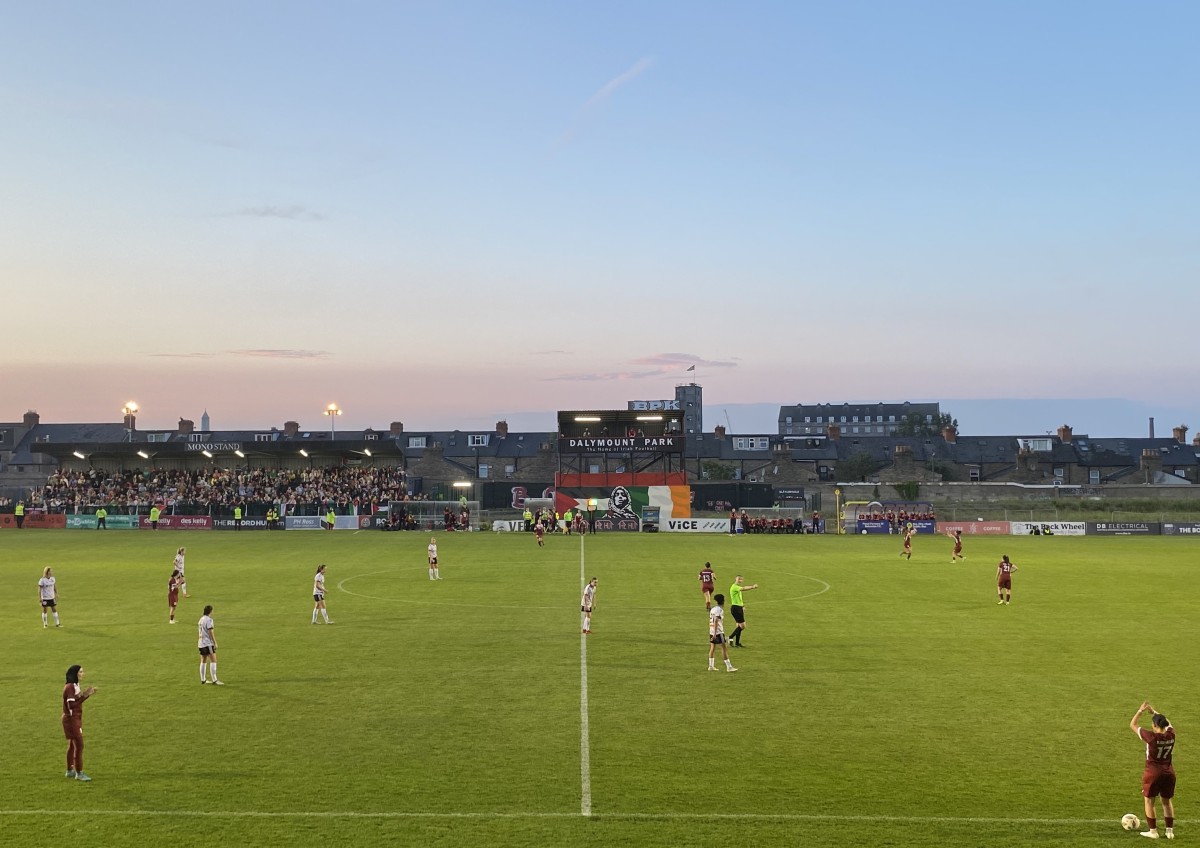
The Palestinian women’s national football team played a historic friendly match against Irish club Bohemian F.C. in Dublin on May 15th, 2024 in commemoration of the Nakba. This piece was written for the limited edition match programme.

At the heart of sport lies the principle of sportsmanship. A simple yet profound ethos that underscores the ordinary act of playing a game, a commitment to fairness and respect demonstrated most visibly by shaking hands and acknowledging your opponent with dignity—in victory or defeat.

This friendly match between the Palestinian women’s national team and Bohemian F.C. gives that ordinary act of sportsmanship an extraordinary significance. Today’s game, poignantly coinciding with the 76th anniversary of the Nakba (the 1948 “catastrophe” where Palestinians were subjected to ethnic cleansing, dispossession, and mass displacement), is more than just a game; it is a reminder of what should be ordinary but too often is not. The simple act of playing a game becomes a powerful symbol of the normalcy that is denied to Palestinians in their homeland—where the Nabka never really ended, as the tragedy of the current genocide highlights.

Today on the pitch, the ethics of sportsmanship dictate that all players are equal, that everyone is bound by the same rules in a fair competition. Today in Gaza and the West Bank, Palestinians face a reality where fairness and equality are non-existent, and every day is a struggle against an occupation where the rules are designed to deny them their very existence. This match acts as a canvas upon which the broader issues of occupation, oppression, displacement, apartheid and genocide are vividly illustrated, and emphasise the need for a world where the principles of sportsmanship extend beyond the game—a world where fairness, equality, and basic human dignity are as normal as a sporting handshake.

Israel’s attempts at erasing Palestinian life and identity are relentless, manifesting as unimaginable human cost, profound collective trauma, mass displacement, destruction of infrastructure and the devastation of cultural and academic heritage. The realm of sports has not been spared either, with the decimation of athletic facilities; stadia being converted into mass detention centres; the continued massacres of Palestinian athletes and coaches; and the weaponisation of Zionist propaganda in international sporting events. Even long before the current genocide, Palestinians faced systematic attacks on their sports clubs; targeted abuse and restricted movement of athletes; and repeated devastation of infrastructure—all of which have historically denied Palestinian athletes a level playing field.

There are those who will argue politics has no place in sports, as if the playing field exists in a vacuum, as if sporting bodies have no history of participation in political boycotts against nations that offend the virtues of sportsmanship on a global stage. The international boycott of apartheid South Africa and the swift exclusion of Russia and Belarus by these sporting bodies sit in stark contrast to their current silence and inaction regarding Israel’s egregious violations.

Perhaps then, it is sports that should have a place in politics. When the players take to the pitch today, praise their normal acts of sportsmanship as powerful symbols of the values and standards we demand of our governments and international sporting bodies. The complicity, selective morality, and double standards of these entities cannot be accepted in the face of apartheid. Yet even though their moral authority is questionable, we must still hold them to account, demanding a world where the ordinary act of playing a game should never be considered extraordinary.

While this exhibition match can serve as an important political reminder, it is, above all else, a significant show of solidarity. The enduring resistance of the Palestinian people combined with the long-standing and steadfast support of the Irish people, embodies the best of humanity and provides a glimmer of hope in these dark days. At a time when joy and play and laughter feel somewhat guilt-ridden, or incompatible with the collective grief and trauma being experienced globally, sport can offer rare relief—momentary freedom, even. The soccer tournament in Rafah during Ramadan last month is testament to this, as Palestinians fleetingly found escape and distraction despite their lives continuing to be so violently disrupted and marred by loss. What’s more, against the backdrop of occupation and oppression, Palestinians are affirming their right to life and dignity through the spirit of play, meaning sport becomes an act of resistance and hope remains indomitable.

Sport can be a catalyst for change and peace, and will undoubtedly contribute to future healing and rehabilitation, but for now, we will find solace in the solidarity it offers. Everyone’s attendance here today is a small but potent act of solidarity that acknowledges the humanity at risk of being lost amidst atrocity, while at the same time celebrating the persistence of the Palestinian players. Let this historic friendly match be a tribute to the power of sport to unite, and to remind us of the shared values that connect us all.

Viva Viva Palestina.

Rebecca O’Keeffe is a peace activist, author, and researcher. She is a former international basketball player and member of Irish Sport for Palestine.

Inside Takweer: An Exclusive with The Queer Arab Glossary’s Marwan Kaabour

By Kit Nicholson

Marwan Kaabour

Could you tell us a little bit about yourself and what you do for any readers who might not already know?

“My name is Marwan Kaabour. I’m a Lebanese artist, designer, and the founder of Takweer. I was born and raised in Beirut before moving to London in 2011. I did my master’s degree in Graphic Design at the London College of Communication at UAL which remains, to a large degree, my main profession. In 2012, I started working at Jonathan Barnbrook’s design practice. I have always admired Barnbrook’s approach to design which made space for political and social work in tandem with commercial projects. My own work has also always been politically and socially geared so finding space at Barnbrook was a natural fit. I started off as an intern and, by the time I left, I had been a senior designer for around four years. I worked with some of the UK’s and – maybe the world’s – most exciting cultural institutions such as the V&A Museum, Somerset House, and Art Basel among others. My farewell project was designing the Rihanna book for Phaidon.

Around the same time, in September of 2019, I founded Takweer. I was feeling frustrated that I wasn’t working on projects that I could connect with on a personal level as an Arab and as a queer person. I really needed an outlet for my personal interests and concerns. Additionally, I was also frustrated with how the narrative and discourse surrounding queerness, even within the Arab world, was very much rooted in the Eurocentric notion of how we should express and talk about ourselves. It seemed as if the main cultural references of all of the young queers back home came from RuPaul’s Drag Race. I wanted to counter that.

It all boils down to one moment when I was back in Beirut. I was in Bardo, a famous queer bar that has now sadly closed, and I was watching the drag show that they were putting on. There were around four or five drag queens in the show, and they were all wonderful. It was amazing to see how the drag scene in Beirut was thriving! However, I noticed that, out of all of the queens, only one of them was presenting in Arabic and making local references. At that moment, I remember wondering where the wealth of rich references to our own pop culture had gone. And that’s how Takweer was born. It was a way to reclaim our own history by using our own people’s narratives, histories, and popular cultures. Creating this space was an attempt to preserve this rich history – these references that only exist in the moments we share together or that only spread by word of mouth – before they die out.

Shortly after founding Takweer, I started my own design practice. My practice mainly focuses on bookmaking; I create books for museums, artists, and art organisations. I also develop branding for art and cultural exhibitions and events. At this point, I also began writing for different journals and magazines. It’s all an extension of what I do with Takweer. Most recently, with the ongoing genocide in Gaza, my political work has taken more of a central stage.

I started Takweer without understanding, really, where it was headed. Eventually, I started to view it as this open-ended and ongoing archive. It’s grown amazingly in the last four years. What once was a small passion project now has over 22,000 followers! It’s generated a lot of interest which has been really nice. My most recent project, The Queer Arab Glossary, is the amalgamation of all of the things that I’m interested in: graphic design, writing, languages, bookmaking, looking at the world through a socio-political lens, and putting a spotlight on queer Arabs. The book comes out on June 6, 2024, and it’s the first realised project to come out of Takweer.”

Can you highlight some examples of queer Arab history that you wish everyone knew?

“When you look at intimacy between people of the same sex, it has a long history in the Middle East. Many fluid relationships between same-sex or even non-binary people have existed throughout history. There was often this grey area where people were allowed to flow and where they were seen as simply ‘out of the norm’ or ‘quirky.’

In ancient Arab history, during the era of the first Islamic caliphates, there are numerous mentions of same-sex relationships; they’re mostly about men, but there are a handful that relate to women as well. There was even a specific type of poetry dedicated for men to speak about their love, admiration, and infatuation with other men. The classical Arab poet from the Abbasid Caliphate, Abu Nuwas, would constantly write about his desire for men, in fact. While, of course, there were conservatives who thought it immoral, that wasn’t the dominant discourse around queerness. There’s a famous story which is regarded as the first recorded instance of a lesbian relationship in Arab history from the 10th century. It’s this beautiful love story between two women: Al-Zarqa’ and Hind Bint al-Nu’man. When Hind died, her faithful lover cropped her hair, wore black clothes, and vowed to God that she would lead an ascetic life until she also passed away. She even built a monastery to commemorate her undying love for her lover.

Another famous story is about Abu Musa Muhammad ibn Harun al-Rashid: the sixth Abbasid Caliph. He apparently had no interest in marrying a woman yet would regularly sleep with both men and women. His mother was very concerned that he would never be able to produce an heir. She ended up gathering a group of ladies and cut all of their hair very short in an attempt to have him marry one of these ‘male-presenting’ women. In the end, her plan didn’t work. Her son fell in love with a young warrior who then passed away in battle. We know this because he wrote a beautiful poem in this man’s honour describing him in great detail – all the way down to the colour of his eyes and the shape of his body.

In more recent history, in 20th century Iraq, there was a famous folk singer called Masoud El Amaratly who was a part of the Ahwari community. Masoud was born as a girl but was never interested in doing traditionally feminine things. Eventually, he became a shepherd. One day, however, two men attempted to sexually assault him. In self-defence, he beat them up, took off their clothes, tied them up, and walked them back into town in order to shame them. The townspeople were so impressed by his courage, strength, and bravery that they let him live his life freely as a man. In fact, he is usually referred to with his chosen name rather than his birth name. However, when you read stories about him, you can sense that they tiptoe around the issue of him being a trans man by evasively mentioning his ‘very particular lifestyle.’ While the Iraqi people obviously love him – he’s a huge part of their history and culture – there is also a conservative tendency to reject him. 

There are many more of these stories on Takweer; it’s a very rich archive that I’ve been building up for the past four years. The entries on the archive are organised by submission date, so what was posted in the beginning is just as relevant as what was posted most recently. Just scroll down and make sure to read all the captions! They’re usually very illuminating. The articles are always bilingual in Arabic and English. 

Regarding your upcoming book, The Queer Arab Glossary, could you share with us some of your favourite slang words?

The Queer Arab Glossary

“My favourite word, one that I use with my friends, is the equivalent of faggot. If you wanted to say to your gay friend, for example, something like ‘Shut up, faggot,’ we use tobji in Lebanon. I know that some people might take offense but, whatever, deal with it. I didn’t know what it meant, at first; it’s just a slur that was used against me when I was younger. Because of this book, I finally managed to understand its etymology. So, the suffix at the end of the word – the sound ji – comes from Ottoman Turkish because Lebanon was under the Ottoman Empire for hundreds of years.  It pertains to whatever the word before it is. So, let’s take khodarji, for example. Khodar are groceries so a khodarji would be a grocer. Niswan are women so a niswanji is a womaniser. Going back to tobji, we’ve got the ji. But what about the tob? Obviously, it has nothing to do with top and bottom. I found out that it was actually a word in colloquial Ottoman Turkish that meant gay. The origin of the word has to do with the practice of putting cannonballs inside of cannons which then became slang for gay. So, a tobji is a person who ‘performs the gay.’

The book is divided by dialect rather than by country. We have Levantine, Iraqi, Egyptian, Sudanese, Gulf, and Maghrebi. I decided to forego with nation states as a way to categorise, but I included a legend that tells you in which country each word/phrase is mostly spoken. One of my favourite words is from Tunisia. Shawwaya traditionally means grilling rack. However, there, it’s used to refer to a verse gay man because he has to flip over every now and again like meat on the rack. Another one of my favourites is ‘aqraba which means scorpion. This word refers to a woman, both cis and trans, who’s trying to poach your boyfriend (if speaking about a gay couple).

One thing that’s very particular about queer Arabic slang is, like Arabic, it’s very poetic and very visual. It’s heavy on metaphor. Some phrases really just paint a whole painting with only a couple of words. What I really wanted to capture is that humour and wit alongside this sense of macabre in a lot of the words. They really run the full range of emotions.”

Can you walk us through your investigative research process for The Queer Arab Glossary?

“I used Takweer and its followers as my main sources. In lock-down, which is when this project began, I posted a series of stories with a submission button where I introduced people to the research I was trying to do and asked them to tell me what words they were familiar with from their own languages, slang dialects, and/or localities. I asked them what these words meant to them and who normally uses them. The submissions were endless – just dozens and dozens and dozens of submissions. I then repeated this exercise multiple times and it very quickly grew to a few  hundred submissions. It became a collective community project.

After I finished compiling the raw data, I began speaking with people on a one-to-one basis. I spoke with multiple people from each country and locality, people from diverse socio-economic backgrounds, and those who identify with the different gender and sexual identities along the queer spectrum. I approached people who spoke different dialects to confirm if they were familiar with these submitted words. I also asked if they themselves would use these words as well as which communities generally would. Sometimes you get contradictory accounts (which are both valid), so you have to admit the multiplicity in meanings. With queer slang, whether something is derogatory or endearing is always relative. Who is saying the word defines how it is. You always have to acknowledge both sides. 

Then, for the very important final step, I had the honour of working with Suneela Mubayi. She’s a translator and independent writer of Kashmiri, Indian, and American Jewish descent. She’s amazingly fluent in Arabic; it’s wild. She has written extensively about a lot of queer issues, so she joined me as a co-editor of the Glossary. Her extensive historical knowledge gave brilliant context to a lot of the entries which she managed to situate historically, socially, and politically.”

Where do you see yourself in the future? Where do you envision this project going?

“I don’t know, yet, what I would like to do next. I’ve been practising graphic design for over 15 years now, and I love what I do but I can see myself starting to drift slightly away from actively practising it. Maybe I’ll take on an art director role that allows me to create work for myself while maintaining a design practice. I think nothing has brought me more joy than making this book as well as starting and nurturing Takweer

The thing is: those projects make you no money whatsoever. All that I’ve done with Takweer has been without a single dime – it’s really just a labour of love. But, if I’m able to sustain myself and continue to produce work under the Takweer umbrella, that’s what I would like to do. I have more books in mind. There’s also exhibitions, workshops, and music-related project performance pieces that I have in mind. If I’m able to realise these projects – or even just a small handful of these projects – I would be very happy. But, yes, maintaining a space where I’m able to express my work in a multidisciplinary manner is where I’m at.”

Do you have any advice that you would like to give to other queer Arabs?

“For Arabs, specifically, if you come from a conservative, traditional, or difficult environment that you don’t feel is able to provide you with the love and the care that you deserve and are entitled to, just make sure you reach out to whoever is in your vicinity that can allow you to be embraced. Know that you’re definitely not the first nor will you be the last. Many have walked this path before, and it is possible to find joy and happiness. I know it’s hard, but try not to dwell too much in the harshness of that reality and try to grab whatever power and strength you have and direct it towards finding those people who will be able to provide you with that love. Our situation back home isn’t ideal, but the care is there. You just have to try and look for it.

For queer people around the world, my advice is to not get hung up too much on identity politics. Yes, it’s important to be recognised for who you are. Yes, it’s important to be visible and included. However, you are more than just a queer person; you are a full, complex, and contradictory person with needs, wants, and emotions that sometimes exceed your queerness. I find a lot of us getting stuck on labels and often saying: ‘I’m queer, and that’s what I’m all about.’ Great, Mama, but you are also so much more than that. Explore that and break out of the box that we’ve been trying so hard to break open; don’t put yourself back into it.”

What does feminism mean to you? How does it relate to queerness and everything else that we’ve talked about today?

“To me, they’re the same. You can’t be one without being the other; it’s always been that way for me. I’m very privileged that I was brought up in a feminist family and household. My mother’s side comes from a long lineage of women who have put the man aside and taken control of the ship, so to speak. I grew up with my six aunties and my many female cousins who never even allowed me to not be a feminist. To be honest, I just know that being a feminist is all about being a good and decent human being and not being an arsehole. That’s pretty much it. If there’s any bone in your body that somehow perceives a woman as being any different or any less than a man, then your moral compass is fucked, and you need to get it fixed. 

What does it mean to me? It means looking at people as individuals who are multifaceted, complex, and often contradictory and accepting them. The minute you start to introduce hierarchy into any kind of group of people, you’re doing it wrong. It’s about not having hierarchy when you look at human beings. Instead, just look at them for who they are and treat them with that kind of respect. It’s almost banal and redundant to be saying these things, but the basic essence of it is not being an arsehole. That’s it.”

———-

For further information and to keep up to date with all of Marwan’s work, check out his website and follow him on Instagram at:

@ustaz_marwan

@takweer_

To pre-order The Queer Arab Glossary (available June 6, 2024), see here.

Marwan is also selling limited edition prints here to raise funds for the Palestinian Youth Movement. 70% of all proceeds will go towards charity.

Finally, see Marwan in conversation with the Bishopsgate Institute:

Liberation Fronts: Marwan Kaabour

I condemn your silence: Sexual violence against Palestinian women

By Lina AbiRafeh

This piece, used with permission, is an abridged version of the original which is published here.

Earlier this week, a collection of independent UN experts confirmed what we always knew to be true — raising serious concern about the credible and ongoing violence against Palestinian women at the hands of the Israeli military both in Gaza and in the West Bank. The title of the article — UN experts appalled by reported human rights violations against Palestinian women and girls — says it all.

Among a litany of other shocking human rights violations, at least two women were forcibly raped while many others were threatened with sexual violence. This is the tip of the proverbial iceberg. Palestinian women also have been forced to strip in front of male Israeli soldiers to be aggressively searched. Photos of these women were then posted online. Given that modesty is a huge part of many Palestinian women’s lives and beliefs, this sexual harassment becomes all the more violent.

And it’s not just women. Abdullah al-Zaghari, head of the Palestinian Prisoners’ Society, stated that detained Palestinian men have faced similar instances of sexual violence such as humiliating strip searches, attacks on their genitals, and attempted rape.

Ultimately, the experts have surmised that these acts are violations of international human rights and humanitarian law — to add to the already-enormous list of violations thus far.

Now before anyone gets all tangled up with the “failure to condemn” rhetoric, let me be very clear: I do not accept or condone sexual violence against any person, at any time, for any reason. And, I recognize that perpetrators are always responsible for their actions — whether they be Hamas or the Israeli Forces, or anyone else.

An Israeli activist group supporting survivors of sexual assault released a report outlining the sexual violence that occurred during or immediately after 7 October to Israeli civilians at the hands of Hamas insurgents. The story is the same — reports of forced rapes, humiliations, and other sadistic practices are made explicit.

Let me repeat: I do not accept or condone any of it. And — I believe survivors.

However, I also believe that the Israeli propaganda machine has been out in full swing these last five months. Yes, documented evidence is challenging to obtain in every context of conflict, but many have explored these allegations and claim that the evidence does not align. Instead, it is being used to justify and manufacture consent for the ongoing genocide.

I also believe in independent survivor-centered investigations for all cases of sexual violence. Israel is refusing to participate in independent investigations of these claims. And yet supporting women should also mean protecting them and seeking justice through these mechanisms. The failure to do so raises concerns.

I align completely with the recent Open Letter to the Israeli and US Governments on how they have weaponized the issue of rape. The letter argues that the issue of sexual violence has been wielded as a tool of war and a weapon of racism and colonialism by the Israeli government “to both legitimize — and divert attention from — their campaign of ethnic cleansing, to dehumanize Palestinians, and to vilify those who criticize their actions.”

The Open Letter goes on to say that Israel has been actively discrediting feminists of color, Arab feminists and Jewish anti-Zionist feminists in an attempt to “incite public fury and deflect attention from the genocide it is perpetrating.”

As a feminist, I do not accept this accusation.

I’ll say it a third time just in case: I can condemn sexual violence and also condemn genocide. I can condemn violence against women everywhere and also recognize the disproportionate impact on Palestinian women.

Sexual violence is — to me — the world’s worst crime. It is too often perpetrated with impunity. And it is rampant during warfare — as an acceptable tactic of war. I know this all too well — it used to be my job.

Palestinian women have endured decades of denial of bodily autonomy and integrity as well as sexual violence — for the duration of the occupation. Sexual violence against Palestinian women by Israeli security forces is most common at checkpoints or during house raids. This includes all forms of sexual violence as well as public strip searches. Palestinian women also experience sexual violence while visiting their relatives in Israeli jails, when attending court hearings of their relatives, and during interrogations — by both male and female interrogators.

Even before this latest round of violence, Palestinian women lacked access to sexual and reproductive health services due to Israeli restrictions on their freedoms and movements. And Gaza in particular has been under Israeli control — and blockade — for decades. The deliberate destruction of an already feeble healthcare system is a crime.

Periods don’t stop in a crisis. There are no pads or other safe alternatives. Instead, there are dangerous period-delaying pills or pieces of tent fibers as pads. Contraception is practically zero, meaning that unintended pregnancies, sexually transmitted infections, and urinary tract infections are all on the rise with no access to medical care.

And if that isn’t painful enough, there are many disgusting examples shared across social media showing Israeli soldiers dehumanizing Palestinians by rifling through, making fun of, and taking photos with Palestinian women’s underwear in their deserted and destroyed homes.

In short, Israeli violence continues to wreak havoc on the bodies and lives of Palestinian women in every imaginable form.

And that’s just the physical stuff. The sheer trauma and psychological toll will last for generations. It has already lasted 75 years.

As I’ve said before, Palestine is a litmus test of our feminist commitment to all women and girls. Everywhere. Without exception. So far it rings rather hollow.

Meanwhile, every day my feminism continues to be questioned precisely because I speak about Palestinian women. Ironic, when I question everyone else’s feminism for not doing so. The question of Palestine is the line in the sand for feminists and all so-called liberals in the West. What’s more, Western feminists are quick to condemn Hamas — or any violence perpetrated by Palestinians — without a word about the extreme violence perpetrated by Israel.

And even now, as more evidence of sexual violence against Palestinians emerges, Western feminists remain silent.

Your silence has been noted. And this is what I condemn.

Read the full article here.

Gaza Genocide: Voices from Rafah

by Rebecca O’Keeffe

The most dangerous stage of the genocide is about to happen. Extermination – the last step in Israel ethnically cleansing Palestinians from Gaza.

The Israeli Occupation Forces (IOF) are preparing a ground invasion of Rafah. For context, Rafah is the southernmost point of Gaza, shares a border with Egypt, and was designated a “safe zone.” Rafah is only 64 sq km (25 sq miles) in size and, with 1.5 million displaced Palestinians trapped there, is now one of the most densely populated places on earth. 

The US-backed IOF have already begun airstrikes, coming after Israeli Prime Minister Benjamin Netanyahu’s rejection of a ceasefire proposal from Hamas, saying he would expand the offensive into Rafah. Further escalation will make it the deadliest massacre yet because, in the words of Lynn Hastings, Humanitarian Coordinator for the Occupied Palestinian Territory, “there is no safe place in Gaza and there is nowhere left to go.

We have watched the world’s most documented genocide unfold in front of our eyes while our so-called world leaders have enabled and funded Israel to continue its massacre of Palestinians. International media has dehumanised Palestinians and demonstrated blatant bias and hypocrisy. The vast majority of Western politicians have refused to speak out, intervene, and have not acted in a way that is representative of public opinion. Even after South Africa’s historic case at the International Court of Justice, which ruled Israel is plausibly committing genocide, one might question whether countries are applying enough diplomatic pressure and taking every action in their power to prevent genocide – action they are obliged to take under the Genocide Convention.

While attention has focused on Gaza, it is worth noting there has been an escalation in Israeli settler and army violence across the West Bank and in East Jerusalem. It is also worth noting that due to Israel’s 17-year blockade, Gaza was already a humanitarian crisis before the genocide. However, experts say the rate of death and destruction in Gaza is the deadliest of the 21st century. Specifically, over the last four months, Israel has massacred at least 28,340 Palestinians, injured nearly 68,000, detained 4,000, and forcibly displaced nearly 2 million people. Israel has damaged 355,000 homes, destroyed schools, bakeries, places of worship, and hospitals – there are no fully functioning hospitals in Gaza, according to the World Health Organization. There are acute shortages of shelter, electricity, clean water, food and medicine. 

Israel is starving Gaza – a direct result of the occupation’s genocidal policies.

And, as evidence shows, in such circumstances, women and children are disproportionately affected. In Gaza, nearly 1 million women and girls have been displaced, women and children make up 70% of civilian fatalities, and two mothers are killed every hour.

In four months, more than 12,300 Palestinian children have been killed by Israel.

If this alone does not stop anyone in their tracks, then humanity has failed on such an incomprehensible scale.

Yet, at the same time Palestinians are not numbers. These figures do not capture their lives, hopes, dreams, and dignity. There are stories behind these numbers. And if the numbers have not compelled you to do something, let their words speak. In the words of Refaat Alareer, Palestinian poet and professor who was targeted and murdered by Israel, “If I must die, let it be a tale.” The story of Palestine – the struggle against occupation, the quest for justice and liberation, and the hope for a better future – should be told by Palestinians. Their stories will not die with them.

As a feminist and peace activist long involved in Palestinian solidarity, I received the following messages from two women in Gaza asking for help. These are two stories yet they represent the voices and stories of so many. 

Duha Latif is a teacher from Gaza and, at only 29 years of age, has already lived through five wars – miraculously surviving each time, she says. She is married and has two children, Ameer, six and Kareem, one and a half. 

There is a fierce war here, I hope that I can evacuate my kids and leave here safely.

I am interested in spreading the story to many people who can help us get out of here as soon as possible. 

Time is equivalent to life in Gaza now. Every minute passes by a year for us here, and every night our hearts break over the fear of our children. 

Ameer was in his first year of primary school for a month before the war destroyed his beautiful dreams. He always asks me eagerly, “Mom, when will I go back to my school?”

I want to save my children and their lives, no matter the cost, because I feel guilty for bringing them into this life in this patch of land that knows neither peace nor safety. I cannot bear the loss of my sons in this conflict and in this merciless war.

I cannot bear hearing the cries and panic of my children as the rockets fall, and the sound of ambulances terrifies my elder son, causing him fear and depression, and it crushes my heart when I cannot answer his questions: “Mom, will we die? When will the war end? When can I sleep peacefully? 

In addition to the constant threat of death due to this war and the lack of safety, we are suffering greatly from the lack of electricity, clean water, and food. The health situation is very bad; there are no hospitals, no medications, not even the basic necessities of life.

She goes on to explain the difficulty in seeking humanitarian asylum and the large sum of money needed to leave Gaza through the Rafah border crossing, which connects Gaza and Egypt. Duha’s GoFundMe appeal is to cover these evacuation costs, as she says, we do not want luxury; we just seek salvation, we seek safety. The compassion of international communities is our only remaining hope. Please stand with me in this critical moment.

Ghada Saed Abu Samra is a 24-year old entrepreneur from Gaza who has been displaced multiple times in the last four months and is dealing with homelessness and lack of food and clean water. She was one semester away from completing her university studies before the university was destroyed in the bombings.

I’m facing an incredibly tough and the worst time as my family and I have had to relocate seven times since leaving our home in Gaza since the war started – we are currently displaced, homeless, and living in a tent in Rafah. Our house, my four-year-old candle business that was my source of living, and even my university have been all destroyed. Four years working on my business despite the blockade, wars, restrictions, and grappling with the constraints of being a woman in Gaza and I made it, you can see my work here but now we have lost everything. 

On her candle business page, Ocean and Waves, she posted the following:

Crafting candles became my act of resistance against the darkness, symbolizing hope for me when we were denied our basic rights. They didn’t stop at just slowly suffocating us; their aim was to crush our dreams and snatch our lives away as well, amidst the struggle and ongoing war. To me those candles embodied resilience, pushing back against forces trying to extinguish our dreams in the face of oppression. We refuse to surrender.

Now feeling helpless, she continued to me, I’m trying to find hope and rebuild. I’ve started a GoFundMe campaign to evacuate from Gaza and rebuild our lives with my family. Your support by sharing my story and the link would make a world of difference.

Ghada is trying to evacuate and get to safety abroad. This is a last resort.

Duha then also updated me:

The situation is getting worse. They are preparing to arrive in the area where I live. 

I asked if her family was safe.

Situation is very bad here in Rafah. They said they will attack within some days. I don’t know where we can go.

So until now we are safe but after today, I don’t know what will happen. A very bad feeling that cannot be described. 

These women demonstrate how Palestinians have remained resolute and dignified, tirelessly showing us time and again what humanity really means despite Israel’s – and the world’s – attempts at their erasure.

This is everyone’s moral litmus test

We need to show up and not lose hope. We must continue to act. To pressure. To mobilise

So, what can we do?

Donate through their links: Duha and Ghada; keep following and amplifying Palestinian voices on the ground; apply political pressure whenever and wherever you can; participate in demonstrations and rallies; read credible news sources; have conversations with family and friends. There is a comprehensive Palestine action guide written with Dr. Lina AbiRafeh, detailing these actions and more.

It all counts and it is more urgent than ever.

After the strikes on February 11th, described by many Palestinians as among the worst and most terrifying nights, I reached out again. I do not know when, or if, I will get another update from either Duha or Ghada. Duha’s last words to me were:

We are still alive. Pray for us.

The world did not start on October 7th

By Anon, 25th October

The Wall in Bethlehem

It’s been 17 days of an emotional rollercoaster of despair, heartache, a sense of helplessness and anger. I have been paralyzed for 17 days, not able to function or focus on anything but the constant updates from Palestine.

17 days of watching a genocide underway executed by Israel, funded by the US and with a carte blanche from the EU.

17 days of seeing the most horrific, gut-wrenching, footage imaginable of charred babies, body parts being pulled from under the rubble, parents bidding farewell over what is left of the corpse of their children, children screaming for their lost parents, parents writing the name of their children on their bodies so they can be identified, hearing from parents that the whole family sleeps fully dressed in case they get that “considerate” 10 minute warning to evacuate before they obliterate their homes, and Gaza turning into a site straight out of an apocalyptic film. And there is plentiful footage getting streamed that you can see for yourself if you are following anything other than the heavily biased, one-sided, mainstream Western media.

Some numbers:

Death count as of yesterday: 5,087 (62% are children and women)

Number of injured: 15,273

Number of people no longer living in their homes: 1,400,000

Number of residential buildings attacked: 181,000+ (of which more than 20,000 turned into complete rubble)

Number of schools attacked: 177 (32 of which completely demolished)

The healthcare system is collapsing. Hospitals have run out of medical supplies, doctors are operating on the light from mobile phones, they are treating wounds with vinegar, they are drastically over capacity, premature babies in incubators and patients on life support machines their lives are completely dependent on how long before the fuel runs out (expected to last for another 2 days). Israel has cut off access to electricity and suspended water supply. Essential resources such as food and water are in short supply. Israel has not allowed any form of aid in (aside from the 20 trucks that went in, apparently with a big supply of body bags, that doesn’t represent 4% of their daily needs). People are seeking refuge in overcrowded hospitals, schools and churches. I can’t even begin to imagine the living conditions.

That kind of hopelessness and despair, coupled with a complete absence of any efforts by world leaders to change things, is what led to the emergence of a resistance movement. And think what we may, the right to resistance is a right by International Law that is not restricted for those who the West deems worthy of living.

And what was the situation in Gaza before October 7?

The total population is 2.2 million, it is one of the most densely populated area in the world.

70% are refugees expelled out of their homes in other parts of Palestine
47% are children
80% of youth are unemployed
82% live under the poverty line

Gaza is basically an open-air prison that has been besieged by Israel for over 16 years, and repeatedly attacked by Israeli military (in 2008/9, 2012, 2014, 2018/19 and 2021). Israel controls the airspace, the water and the land. They control who and what gets in and out. There is a, heavily guarded, turnstile gate people must walk through for those who get permission to leave, and most of the time, permission is not granted. Save the Children this year announced that between Jan and June of this year, 400 Palestinian children were denied permits to get urgent treatment outside of Gaza.

Beyond Gaza


It is not just Gaza. Palestinians have been dealing with 75 years of brutal occupation, oppression, ethnic cleansing and living under an apartheid system that Israel has imposed on Palestinian people. Palestinians live under the unjust military rule of Israel. They have no rights.  Israel has been identified as an apartheid state implementing a system of apartheid that persecutes Palestinians by several human rights organization including Amnesty International as well as Israeli NGO B’Tselem. There is plenty of reading material online to what this apartheid system looks like for those interested.

And while Israel likes to accuse Hamas for the reason for the attacks, you just have to look at the West Bank where Hamas does not exist. The apartheid system impacts them as well restricting Palestinians right to movement (there is an over 700km apartheid wall Israel built on West Bank land breaking up families). Israel has confiscated over 500,000 acres of Palestinian land and allocated it for settlers and since 1967 Israel has illegally settled more than 441, 000 settlers in the West Bank. And while our attention is on Gaza, Israel has been arming Israeli settlers who have been assaulting Palestinians under the eyes and security of the Israeli army. 95 Palestinians have been killed by Israelis in the West Bank since October 7th.

Peace, that we all seek, will only come when the root cause of resistance ends. End the occupation, end the oppression, end apartheid, give the Palestinians living in the diaspora the right to return to their homeland. Then we can move to the healing part and towards a more sustainable future for all.  But, if the peace you want simply looks like Palestinians accepting the status quo, I’d take a hard look on what that says about your values and if you truly believe in human rights for all.


I am granddaughter of Palestinian refugees. I carry the pain of my people and the injustice of the world in allowing for an apartheid system to exist in 2023. My grandparents were forced out of them homes and like many from Yaffa, were pushed to the sea where they took boats to reach Beirut. My grandparents died at the ages of 90 and 97 a few years ago, never getting to go home. Except that is for my grandmother who, thanks to Alzheimer’s in the last few years, was lucky enough, in her mind, to have returned and we got to go with her on that journey of being in Yaffa.


Palestinians are attached to their land, are attached to their identity and are attached to their humanity. They are fighting for their freedom. There is a lot of generational trauma and pain. We will not be able to heal till we regain our basic human rights.

It is important to understand how we got here to figure out how we move forward.

I have included below some accounts you can follow should you choose to learn more about the reality of what is happening and some books and documentaries you can read/ watch to learn more about the history.

Accounts to follow (on Instagram):
Motaz Azaiza
Plestia Alaqad
Institute for Middle East Understanding (IMEU)
Eye on Palestine (Note: since the time of writing this account has been removed by Instagram. It is available on Telegram)
Craving Palestine
Mondoweiss
Yara Eid
Noura Erakat
Sim_bookstagrams_badly (Sim Kern)
Shaun King

Miko Peled
Breaking the Silence

*Editor’s Note: Since the time of writing the figures have increased to:

Gaza: 6,546 killed and 17,439 wounded

West Bank: 103 killed and 1,836 wounded

This is in no way intended to reduce these souls to numbers but to record the genocide that is occurring in real time.

We should author our own futures – A Story from Jordan

Over the years YallaFeminists has sought uplift the voices of women. To convene women from around the world in conversation, to create solidarity and to “pass the mic”. Recently a woman from Jordan, who will remain anonymous, reached out to us and asked us to share her story. Jordan has discriminatory personal status codes and discriminatory laws that limit women’s freedoms and deny them protections. Women need the permission of a male guardian to marry for the first time and to travel with their children. Additionally women in Jordan have very limited protections socially and by the courts when it comes to intimate partner and gender based violence. 

This story comes from a woman who was encouraged to seek high levels of education by her family but still faced discrimination from them in regards to who she could seek as a partner. We are happy to share her story, and share in her grief. We believe that it is important to share women’s stories when they may not feel safe enough to do so themselves. 

Woman from Jordan, age 43… 

I was raised in a house where I was told a girl’s weapon is her degree. I had to study hard and have excellent grades so my parents would be proud of me. Speaking about marriage and relationships was forbidden at our house. Girls are not meant to get married, yet I was told “a girl is like a glass, once broken it can never be fixed again.”

I used to watch Ally McBeal when I was in high school and always dreamt of becoming a lawyer, having a job like her, and finding the love of my life!

In reality, I became a lawyer, but I did not work as a lawyer for many reasons. I fell in love but was denied my right to marry the person I chose.

Throughout my undergraduate years at university, I never talked to a male colleague outside of a studying, colleague, or friendship relationship. There were few who wanted to hang out with me. It seemed funny to them but my message to all of them was “let’s be friends, I have to finish my degree. My family will not accept me having a boyfriend, fiancée or a husband because I have to finish my degree.” 

I was not able to share the stories of men who approached me with my mum or my sister. But I can’t deny that I fell in love with one handsome guy. I tried to secretly hang out with him, but after the first time we talked he told me “you are too innocent for me.” Despite all those years passed, I am still not sure if I liked the comment or not.

Being a lawyer was not anything like Ally McBeal. I started my new career and I met people from different countries.. again there was this amazing guy who started talking to me. Maybe because he was the only person who was persistent despite my resistance he was able to get me to have a relationship with him. What bothered me the most during this time was thinking remembering the glass metaphor and what my family would do if they knew that I was dating someone from a different culture. This relationship didn’t last after all. 

One day a guy from my same culture and a “prestigious” family suddenly visited our house looking for a traditional and arranged marriage! My family approved as he came from a well-known family and was educated and they were proud. For me, this was a big NO. I resisted and told the guy I refused to marry him. Luckily he disappeared. 

However, my sister snuck into my phone and learned about my previous relationship. She was angry and mad at me. I told her it was none of her business. She said “you know the rules well, this is not acceptable” and I repeated for her to back off. This was another reminder for me that love and marriage were a No for me.

Years after, I met another guy who was nice and funny but my brothers did not approve.  At this stage, I was getting older and more aware about my rights. But my brothers made the decision to threaten the guy and he disappeared.

Ironically, an opportunity to have a masters in Human Rights in England came to my doorstep. Studying in England was a dream of my dads – and something no one from the family dared to object to. The subject of my masters was an itch for my youngest brother who did not like it and kept making comments I chose to ignore.

I came back with my Masters’ degree and decided fate was telling me to continue with my career path. Marriage is not what life is about. Why bother unless there is someone amazing. I was getting older and in the Arab world women after the age of 30 have less chances to get married. The game was over for me! Then, out of the blue, I met this amazing, young, handsome, caring, funny and open minded guy!! A few months later, COVID hit and there was no way to introduce him to the family. I talked to an old friend who knows my family very well, he told me “your family will not approve, he does not fit the criteria!”. He is 8 years younger than me and does not have a university degree. I thought once they meet him they will change their holy criteria. I told my friend; “Come on, I am in my forties, it is my decision.”

I thought – I was a very supportive sister all those years, so the least they can do is support me with this. They would like to see me happy and at the end of the day, it is MY Life and I have the full right to decide for myself. Unfortunately, it was not the case and my friend was right. No one supported me, my mother and my sister manipulated me and thought only of their own interests. My brothers worried about my inheritance and what portion they were going to take. For them, they were not convinced that someone would marry an “old woman in her forties” and that he must be interested in my money.

One of my brothers was willing to meet him. I thought I could trust him and he might support us but it was not the case. It was an insulting and inhuman conversation. My brother told him he was “from a different class than mine and that he couldn’t keep up with my financial requests.” Though since my father’s death I had never asked for anything from them. I was responsible for my own expenses.

After this, many things happened and I was afraid they would hurt him. Particularly my brother who told him “you know we come from a big tribe and your father and family don’t want to mess with us.” I told my family that I would take the case to the court, and if they did not allow me I would leave the family house. They went crazy and my brother said he would kill me and that I was not allowed to leave the house. Finally, my mum took action because she was scared I would go and raise the issue on social media and with the police. She convinced my brother to let me go to my work and she would talk to me about disregarding the issue. I was scared he would get hurt so I asked him to step back for a bit until my issue with my family was solved. I did not also want to give up my inheritance rights, so thought let me be smart and tell them the issue was resolved and I would get my finances in order and then raise the issue again.

However, they were smarter and things did not go the way I thought they would go. His father insisted that he get married. Within two weeks the deal was done. Both left heartbroken but we could not say or do anything to our families. He told me that his father was rushing things up and he told him “I wanted to save you and us from this big tribal issue but you must cut any connection with me.” I am sure my brothers spoke to the father.

So there I was in my forties, fully aware of my religious and legal rights  and I was not able to live a life I chose. Of course my family learnt about his marriage and they told me  if he really loved you he would not have married. He wanted your money and wanted to misuse your social status. It has been more than a year, I still cannot be the same person as before.

I am worried If I tell the story to anyone they might think the same way as my family about him and think I am overreacting. I am not sure if anyone can feel how disappointed and victimized I feel. I also feel for him, even though someone might say – but he is a man. He is a man – but I know my family, and know that what  they threatened the other guy with 15 years ago, they would have done the same to him.

How long are we supposed to accept that our future is decided by the family and the society? How can we change this? I am worried about my nieces and what the future holds for them. I hope they can live with freedoms that I was not able to have.

Gender based violence is not only about physical abuse. Mental abuse is way worse, the laws which restrict our freedoms are violating our rights.

Please let’s talk about those as well.

Design a site like this with WordPress.com
Get started